Editorial · Updated 2026-06-29
What "Orthopedic" Actually Means in a Dog Bed (and What It Doesn't)
Search "orthopedic dog bed" on any marketplace and you will find thousands of listings sharing one word and almost no shared definition. Egg-crate foam slabs, shredded-fill bolsters, and three-inch commodity polyurethane pads all carry the same badge. The label has become shorthand for "this costs more than the basic bed" — not for a specific engineering outcome.
That ambiguity matters because the dogs who actually need pressure redistribution — senior dogs with thinning cartilage, large breeds carrying hip dysplasia, post-surgical patients spending eighteen hours a day on one surface — cannot afford to guess. This piece defines what orthopedic should mean in a sleep surface, what it reliably does not mean, and how to read a product page without trusting the adjective.
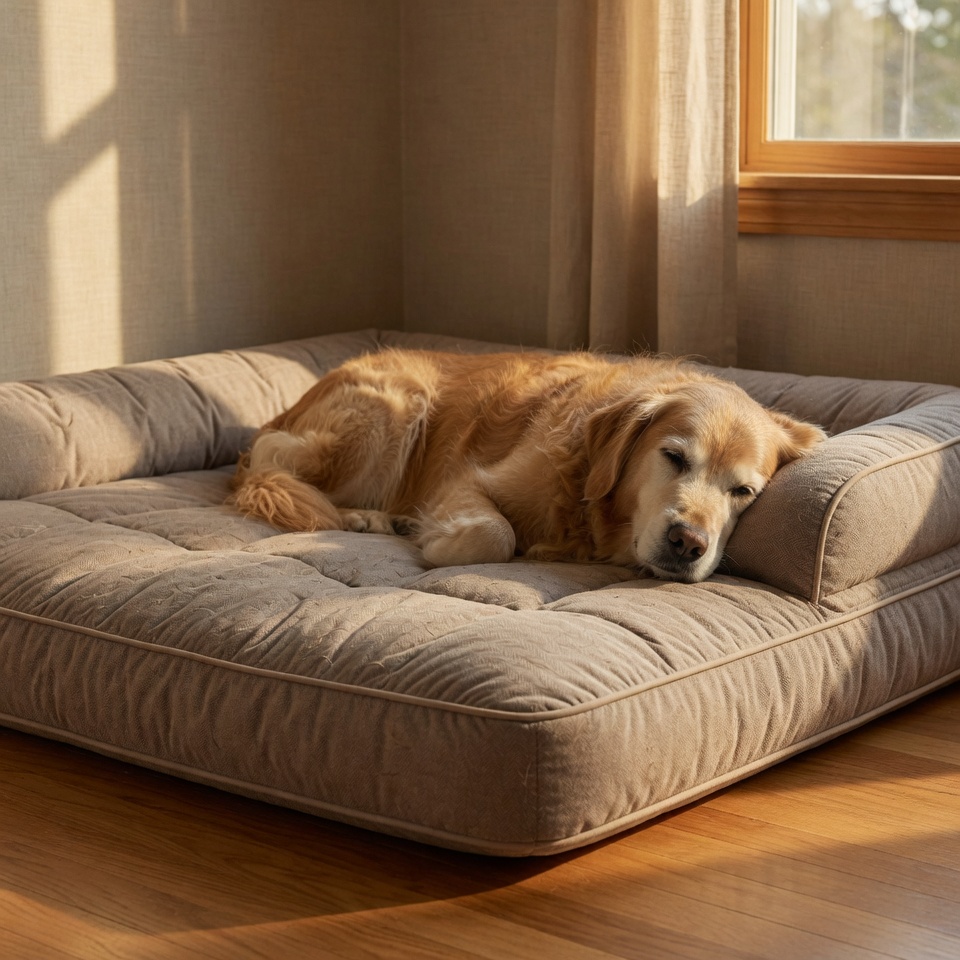
The engineering definition
In human mattress engineering, orthopedic describes a surface designed to redistribute contact pressure so no single anatomical point bears disproportionate load over a long dwell time. The goal is not softness. It is lower peak pressure at hips, elbows, shoulders, and lumbar spine while maintaining enough push-back that the sleeper does not bottom out onto a rigid substrate.
The same logic applies to dogs, with two complications. First, dogs do not lie flat like humans. They curl, they sprawl, they sleep with limbs tucked under the chest. Peak pressure shifts with posture. Second, a senior dog's joints are structurally different: cartilage loss means bone-adjacent tissue takes load directly; muscle atrophy means less natural padding. The bed becomes part of the musculoskeletal system for hours at a stretch.
A surface that qualifies as orthopedic in this sense must do three things simultaneously:
- Support: resist collapse under the dog's weight so the torso does not reach the floor or a rigid platform.
- Conform: allow enough give at the contact layer to spread load across a wider area instead of concentrating it at bony prominences.
- Recover: return to shape after the dog moves, night after night, for years — not weeks.
Plushness alone fails the test. A thick, fluffy bed can feel wonderful for five minutes and still let an 85-pound Labrador's hips punch through to the crate pan by morning. That is not pressure redistribution; it is delayed bottoming-out.
What "orthopedic" does not mean
Because no U.S. regulator defines orthopedic for pet bedding, the word carries no legal minimum. It does not automatically imply any of the following — even when the packaging suggests it does:
- Veterinary endorsement. "Vet recommended" on a retail box is marketing unless a named clinician, institution, and methodology are attached. The AVMA's osteoarthritis guidance for dog owners discusses weight management, exercise, and pain control — not specific mattress brands. Bedding is adjunct comfort, not prescribed treatment.
- Clinical proof. One published trial exists in this category — a University of Pennsylvania study on a single premium brand's mattress. It is worth reading on its merits, not as proof that every orthopedic-labeled bed works. More on that study below.
- Memory foam. Viscoelastic top layers can help conform at the surface, but memory foam is a material, not a certification. Low-density memory foam still collapses.
- Cooling. Gel infusion, ventilated egg-crate tops, and "Arctic weave" covers address heat retention. They do not change whether the support core holds up under a heavy dog.
- Washability, chew resistance, or waterproofing. Real product benefits — orthogonal to joint support.
Treating orthopedic as a materials claim ("contains memory foam") instead of a performance claim ("reduces peak pressure at the hip over an eight-hour rest") is how the category got diluted. The fix is spec literacy, not a different adjective.
Why senior dogs change the calculus
A healthy three-year-old dog tolerates a wide range of sleep surfaces because cartilage, synovial fluid, and muscle bulk absorb and distribute load. By age eight or ten in large breeds, those buffers thin. Osteoarthritis — estimated to affect a substantial share of dogs over seven — alters how force transmits through the pelvis and stifle.
Research on bedding and canine joint disease is thinner than owners might expect, which is partly why marketing fills the gap. A PubMed search on canine osteoarthritis and bedding pressure returns a small set of peer-reviewed work; pressure-mapping studies in dogs are rarer than in human hospital mattress research. That scarcity is not an excuse to invent claims — it is a reason to be precise about what we know and what we are still measuring.
What we do know from clinical practice: dogs with mobility pain often circle longer before lying down, shift position more overnight, and hesitate at the first step off the bed in the morning. Owners interpret those behaviors as personality. Frequently they are load management. A surface that reduces peak pressure does not cure arthritis — but it can reduce the micro-trauma of sleeping on a surface that fights the joints all night.
Specs that separate real support from label theater
You do not need a engineering degree to screen listings. You need three numbers and one structural question. Full decoding of density and ILD lives in a separate spec primer; here is the screening version.
Foam density (lb/ft³)
Density measures mass per volume of the polyurethane core. Higher density generally means tighter cell structure and slower permanent deformation under load. Commodity pet-bed foam often runs 1.5–2.0 lb/ft³. Support-grade orthopedic cores typically start at 3.0 lb/ft³ for smaller dogs and 4.0+ lb/ft³ for large breeds. If a listing will not publish density, assume it is low.
ILD — indentation load deflection
ILD (sometimes reported as IFD) is the force required to compress a foam sample to 25% of its thickness. It is the closest thing the industry has to a firmness number that laboratories can repeat. A comfort layer might sit at 12–18 ILD; a transition layer at 20–28; a support core at 30–40+. Single-slab beds with one ILD across the whole stack are simpler to manufacture and cheaper — but they compromise either conform or support.
Layer architecture
Human orthopedic mattresses use zoned layers for a reason: the shoulders need different deflection than the hips. Dogs benefit from the same principle even without zone cuts — a soft top, firmer middle, and high-density base outperforms one homogeneous block of the same total thickness.
| Listing signal | Often actually is | What to verify |
|---|---|---|
| "Orthopedic memory foam" | Thin visco top over low-density PU | Density + ILD of each layer |
| "Medical-grade" / "hospital grade" | Unregulated copy; no FDA device status | CertiPUR-US is materials safety, not support grade |
| "Egg-crate orthopedic" | Convoluted cut on 1.8 lb foam | Convolutions add airflow, not structural support |
| "Extra thick 6-inch" | Six inches of the same soft slab | Thickness without density = faster collapse |
| Published 4+ lb / multi-ILD stack | Engineered support system | Fatigue behavior over 12–24 months of use |
What good orthopedic foam manufacturing looks like
A foam shop that supplies recovery-grade bedding measures batch density and ILD at intake, not at marketing time. Slabs are cut from known grades, layered with adhesive or mechanical bonding that does not create a soft delamination line, and cured long enough that off-gassing does not get sealed inside a cover on day one. Vertical integration — one facility pouring, cutting, and QC-ing — reduces the "mystery middleman foam" problem that plagues drop-shipped pet beds. A working shop like Foamma USA will hand you the ASTM sheet for the slab they cut; most Amazon suppliers will not.
Manufacturing quality does not replace your due diligence as a buyer. It does explain why two beds with identical cover photography can diverge completely after six months: one was built from characterized foam with a warranty-backed density claim; the other was whatever was cheapest from the broker that week.
The one published clinical trial
The University of Pennsylvania's clinical trial on the Big Barker mattress is the only peer-reviewed, dog-bed-specific outcome study widely cited in this category. Researchers followed dogs with joint disease using a particular high-density mattress design and reported improvements in gait and owner-perceived pain scores over a multi-month window.
The study is useful evidence that bedding construction can measurably affect mobility outcomes in arthritic dogs when the mattress meets a high bar — but it tested one specific product, not the orthopedic category as a whole. It does not prove that egg-crate foam from a warehouse club delivers the same results. It also does not identify a single magic density; it shows that engineering quality matters enough to measure.
Until more trials exist, treat the Penn findings as a proof of concept, not a blanket endorsement of every orthopedic listing. Look for published density and ILD specs, and weigh how the foam stack is built — not how loudly the packaging uses the word orthopedic.
Red flags on a product page
- No density or ILD anywhere — not in the listing, not in the FAQ, not in the manual PDF. If support were a selling point, the spec would be above the fold.
- "Orthopedic" as the only technical detail. One adjective is not a data sheet.
- Review patterns that mention flattening at 3–6 months. Sort by most recent and search "flat," "thin," "bottomed out." Chronic flattening is a foam-grade signal.
- Non-removable covers on deep foam stacks. Hygiene matters for incontinent senior dogs; sealed covers force full replacement when only the core fails.
- Return stories dominated by "dog wouldn't use it." Sometimes sizing or smell; sometimes the dog rejecting an unstable surface. Orthopedic engineering does not guarantee preference — but chronic non-use is a data point.
How to evaluate a bed before you buy
- Request the spec sheet. Email the brand. Ask for density and ILD per layer. A transparent manufacturer answers in one business day.
- Match weight class to core density. Under-spec foam for an 90-pound dog will read as "my dog destroyed the bed" when physics did the work.
- Press-test if you can. In a store or on delivery day, kneel and press the center with both knees. If you hit rigid structure in under two seconds of sustained load, imagine that times your dog's weight concentration.
- Plan for core replacement. Covers outlast foam. A bed with a replaceable core is a longer horizon investment even if upfront cost is higher.
- Consult your vet for acute cases. Post-operative dogs and dogs on pain medication may need surfaces firmer or softer than marketing segments suggest. Bedding supports management; it does not replace veterinary care.
Where this leaves the category
Orthopedic should mean: engineered pressure redistribution with published foam characterization and a support core that survives years of dwell-time load. Everything else — the egg-crate tops, the unmarked polyurethane bricks, the memory-foam slivers on two-pound bases — is comfort retail borrowing a clinical word.
The dogs who need the real thing are not shopping for vibes. They are aging in bodies that hurt when the floor wins. The category gets better when shoppers demand numbers, when reviewers apply the same spec rubric to every brand, and when manufacturers stop hiding behind a badge that lost its meaning years ago.
That is the bar we use for every mattress review, comparison, and buyer guide on this site — including our own products. We publish density and ILD on Padfoundry pads for the same reason we ask for them from every other brand: you cannot compare beds without the numbers.
Frequently asked questions
Does every dog need an orthopedic bed?
No. Young, healthy dogs with normal joint cartilage distribute load well on most surfaces. Orthopedic engineering matters most when cartilage is thinning, muscle mass is dropping, or a diagnosed condition — osteoarthritis, hip dysplasia, post-surgical recovery — means the dog spends long stretches in one posture. For those dogs, pressure redistribution is a comfort and mobility variable, not a marketing preference.
Is memory foam automatically orthopedic?
No. Memory foam is a viscoelastic material that conforms slowly to body heat and weight. It can contribute to pressure relief in a layered stack, but low-density memory foam still bottoms out under a heavy dog. A one-inch memory-foam topper over a 1.5 lb polyurethane slab is not orthopedic engineering — it is a comfort label on commodity foam.
Can a bed be orthopedic without saying the word?
Yes. A mattress with published density, ILD, and a multi-layer support stack can meet orthopedic criteria even if the brand never uses the term. Conversely, a product covered in orthopedic badges may fail every measurable criterion. Read specs, not adjectives.
How thick should an orthopedic dog bed be?
Thickness is a function of dog weight and foam grade, not a magic number. A 3-inch slab of 1.8 lb foam collapses under an 80-pound dog; a 5-inch stack of 4+ lb foam with graduated ILD can hold support for years. Rule of thumb: if you can feel the floor through the center of the pad with both hands while the dog is off it, the support core has failed regardless of what the listing claimed.
What does CertiPUR-US certification tell me about orthopedic quality?
CertiPUR-US verifies emissions, prohibited flame retardants, and heavy-metal limits in polyurethane foam. It is a materials-safety certification, not a support or durability certification. A CertiPUR-US slab can still be too soft, too thin, or too low-density to redistribute pressure for a senior dog.
Are bolster sides orthopedic?
Bolsters are perimeter support and draft protection. They can help a dog brace when getting up, but they do not replace a supportive sleep surface. Many orthopedic-labeled beds are standard polyurethane slabs with stuffed bolsters — the bolsters get the marketing photos; the floor-contact layer does the actual work.
Does a cooling gel layer make a bed orthopedic?
No. Gel infusion changes heat retention in viscoelastic foam; it does not change load-bearing capacity. Cooling claims and orthopedic claims are independent engineering problems. A bed can be cool and unsupported, or supportive and warm.
What is the difference between orthopedic and therapeutic?
In human bedding, therapeutic often implies a clinical use case. In pet retail, both words are unregulated. Neither term guarantees density, ILD, layer construction, or third-party pressure testing. Treat them as copywriting until the spec sheet proves otherwise.